Case study
terukisato.dev
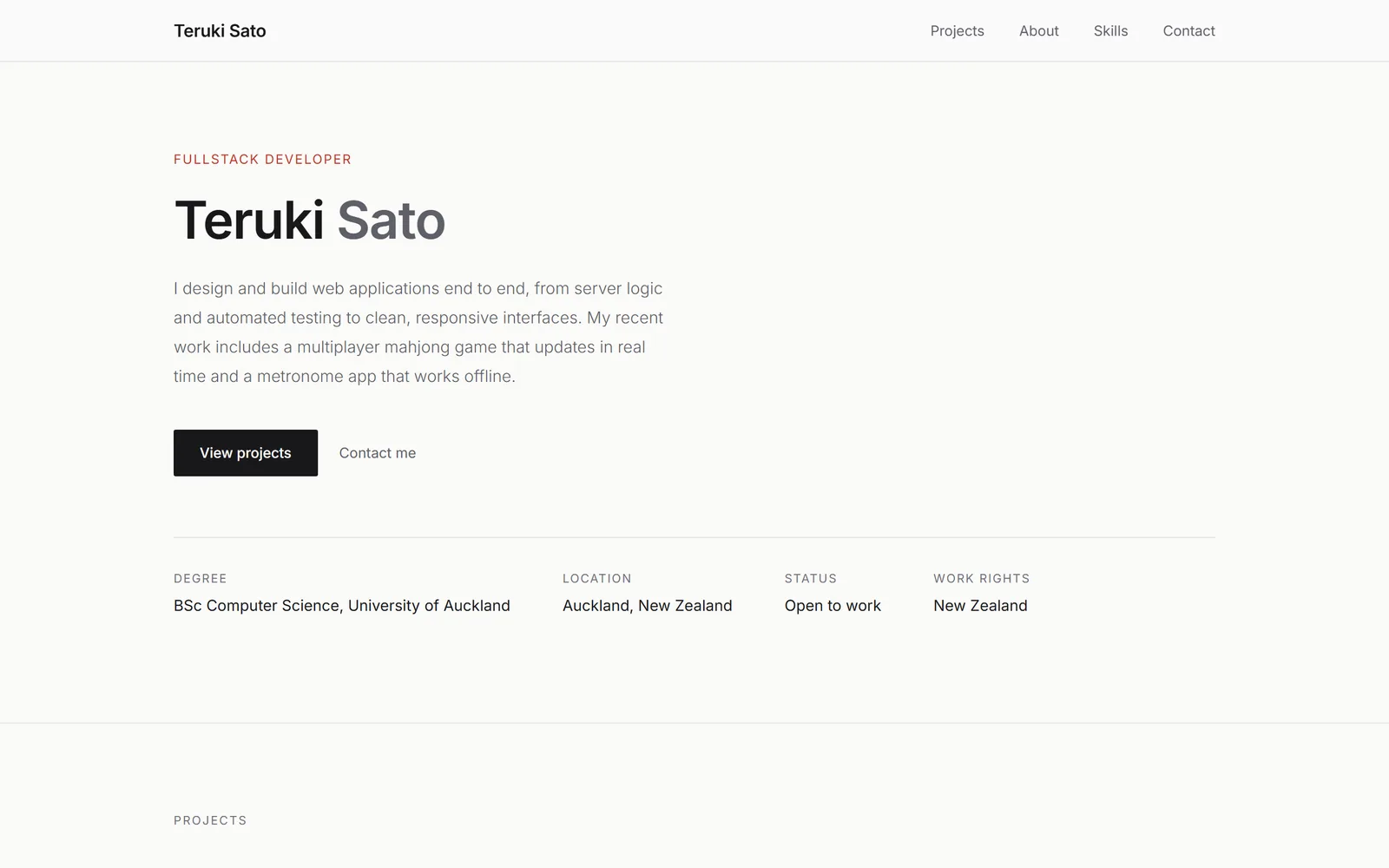
This portfolio site, built with React and TypeScript. Every page is rendered to static HTML at build time, so it loads quickly and shares cleanly, and all of its words live in one typed content file.
- Role
- Solo project covering design, development and deployment
- Tech stack
Overview
I built this site to present my projects in more depth than a CV allows, and to show the React and TypeScript side of my work. It has a home page and a case study for each project.
Rather than adopting a full framework, it uses a short build script that renders each page to HTML with React’s server renderer, then lets React take over in the browser. The result is a fast, fully static site with only three runtime dependencies.
Key highlights
- React 19 and TypeScript, built with Vite and hosted on Vercel
- Every page rendered to static HTML at build time, with its own title, description and link preview
- A small route matcher in place of a routing library
- All copy in one typed file, kept separate from layout code
- Accessible by default: skip link, visible focus, AA colour contrast and reduced motion support
- A script that drives headless Chrome to capture project screenshots and demos, plus the link preview card and icons
Challenges & decisions
Static pages without a framework
A build script renders every route to its own HTML file. In the browser, React attaches to that HTML only when it matches the current page, and renders afresh otherwise, so a host falling back to the wrong file can never leave the page mismatched.
Content separate from layout
Every word on the site lives in one typed content file, merged with project facts such as links and tags. Components only handle layout, and the build fails if a project is missing its copy.
Accessible from the start
Text colours were chosen to meet WCAG AA contrast, animations respect the reduced motion setting, and content that fades in on scroll appears immediately when JavaScript is unavailable.
Images that stay current
Project screenshots, demo animations, the link preview card and the icons are all generated by one script, so updating them after a project changes takes a single command.
What I learned
- Rendering pages at build time gave fast first loads and complete link previews without the weight of a full framework.
- Putting all content in one typed file made editing safer: the compiler catches a missing field before the site is published.